What did Modi and Trump discuss in G7 Summit
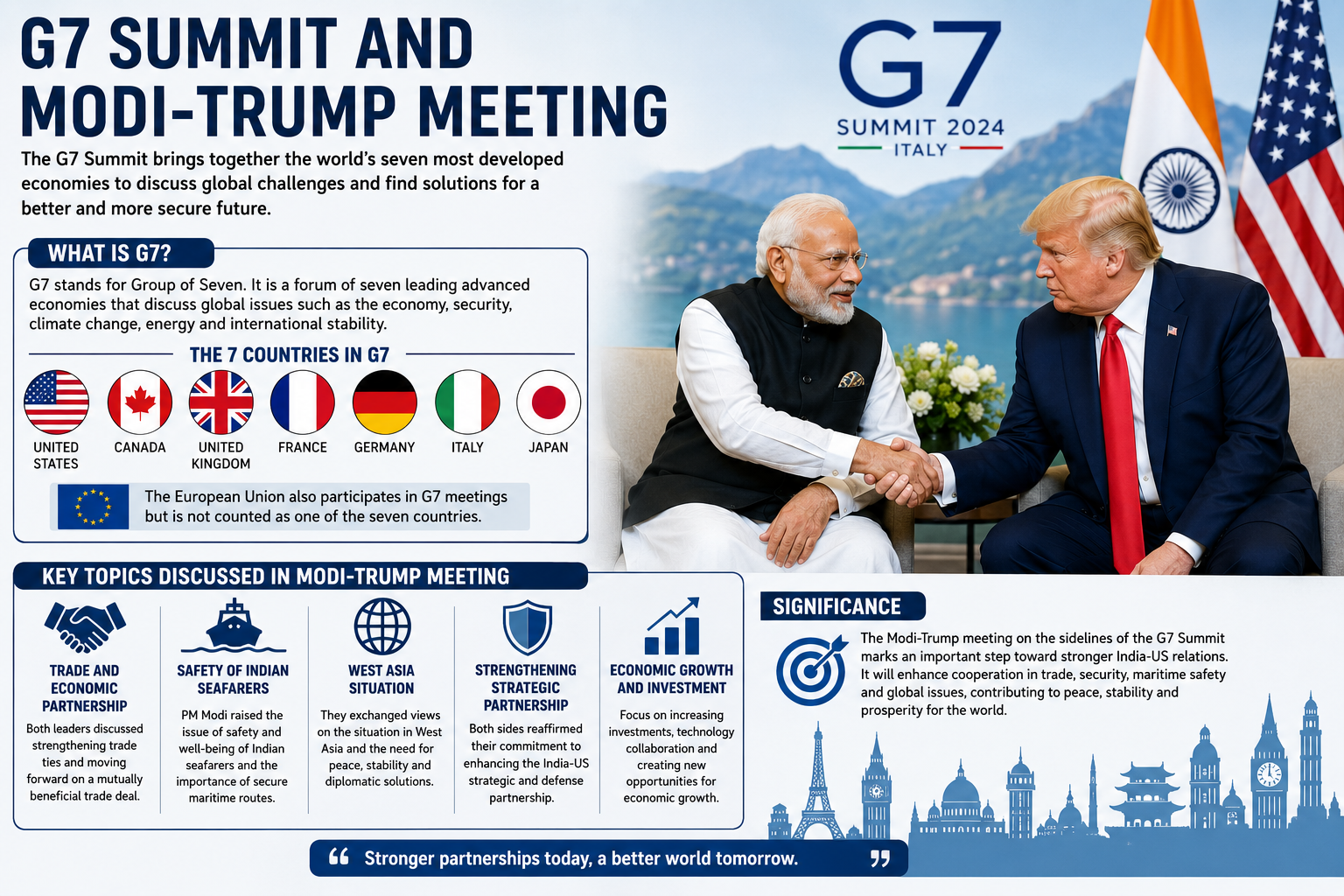
The G7, meaning the "Group of Seven," is an important group of the world's seven developed countries. It includes the United States, Canada, the United Kingdom, France, Germany, Italy, and Japan. This summit was held in Evian-les-Bains (Haute-Savoie), France. The group discusses important issues such as the global economy, trade, security, energy, and climate change, and works to shape global policies.
Modi and Trump
The G7, meaning the "Group of Seven," is an important group of the world's seven developed countries. It includes the United States, Canada, the United Kingdom, France, Germany, Italy, and Japan. This summit was held in Evian-les-Bains (Haute-Savoie), France. The group discusses important issues such as the global economy, trade, security, energy, and climate change, and works to shape global policies.
What was discussed in the meeting between Narendra Modi and Trump?
Most of you know this already. But in particular, we had a very good conversation with India's Prime Minister Modi, and we are making trade agreements. We are doing many things. A lot is happening between the United States and India. The United States is performing better than ever before. We have more than $19.2 trillion in investments coming in. And we are building factories. We are building everything. And the Prime Minister is also building a lot in the United States. He is spending a lot of money in the United States. So we appreciate him for that. But I just want to say that he has been my friend for a long time. And we have always had a very good relationship. And it is wonderful to be with you. Thank you very much. It is wonderful to be with you. Thank you.
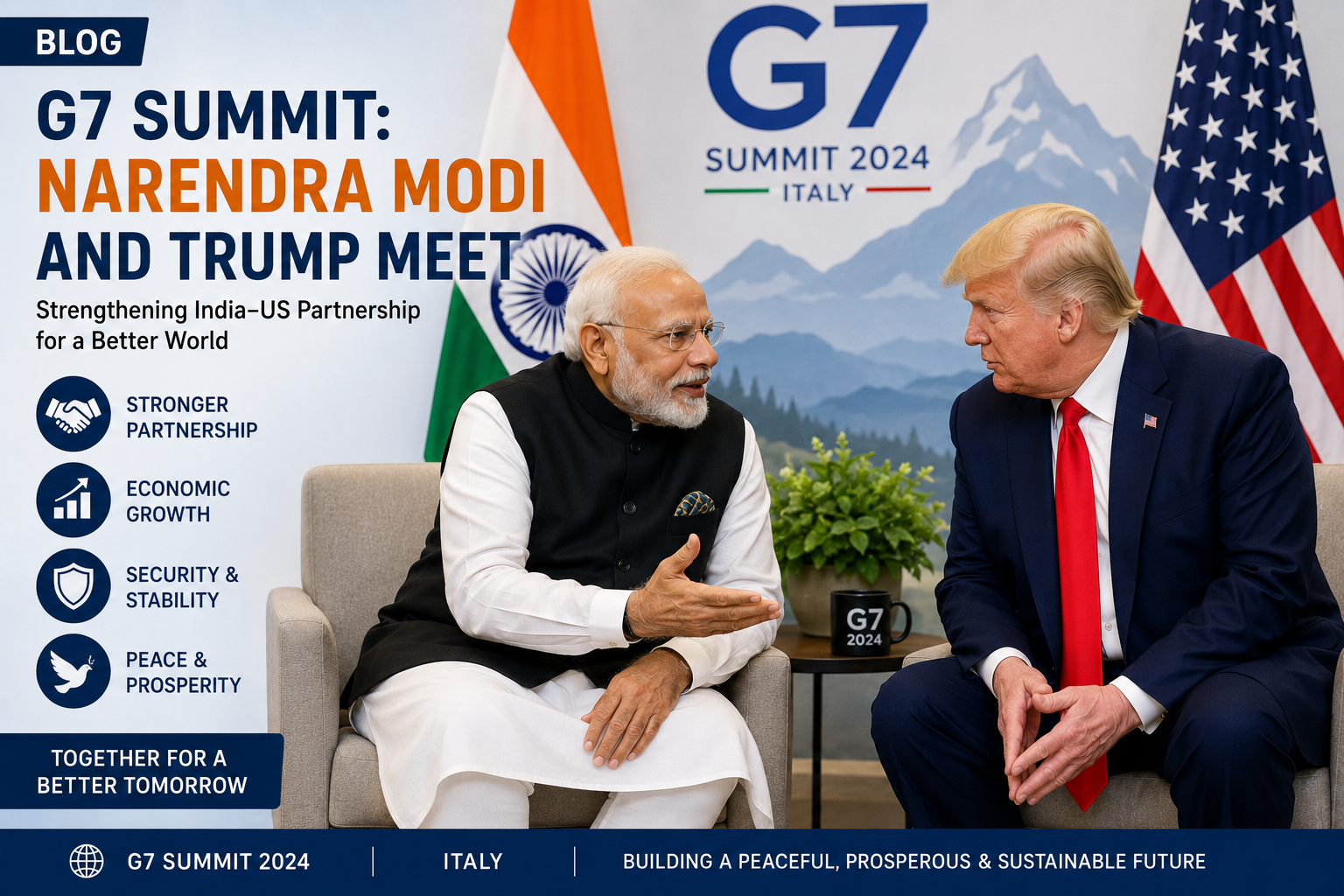
Mr. President, I am very pleased to meet you. Last year we met in Washington. Since then, our relationship has gained new energy. And in many areas, we are moving forward together.
Mr. President, it is a pleasure for me to meet you here in Evian. We had a very meaningful meeting in Washington last year, and since then we have given our relationship new momentum and new energy, and we are working together in many fields.
And we are also pleased to see that our teams are working in close coordination and active engagement, and they are working toward achieving the goals that we set for ourselves last year.
Mr. President, I appreciate your leadership for the progress made in efforts to restore peace in West Asia. Thanks to your efforts, Mr. President, a new hope for peace and stability has once again been awakened in the region, and I believe this will establish lasting peace there.
Mr. President, you and I agree that keeping the Strait of Hormuz open is extremely important for the global economy. India has always emphasized the importance of ensuring freedom of navigation, and we should pay special attention to this together.
As you know, millions of Indian sailors are serving in the world's seas. They are contributing to the world's development. I believe their safety is as important as the security of the world.
Mr. President, you know that millions of Indian sailors around the world are working and providing services on global maritime trade routes, including the Strait of Hormuz, and their safety is our highest priority.
Mr. President, you have made extraordinary efforts to reach this understanding and this agreement, and I believe that during the implementation of this agreement, the issue of sailors will be given the highest priority.
Mr. President, once again I deeply appreciate your efforts to ensure the restoration of peace and the reestablishment of peace and stability in West Asia.
Press: How close are you to a U.S.-India trade agreement?
President: Very close. We have been there for some time. These are very tough negotiators. In fact, among the toughest. Look at this man. Let me give you a lesson. He is the most handsome-looking man. Looks so good. Like an angel. But in reality, he is extremely tough—he is a killer. I don't want to say it—he is a killer. As tough as anyone can be. But he looks so good that he surprises you. There are very few people like that. People say, "He is a very nice person." I say, "No, he is very tough." He is a tough businessman, and he loves the Indian people, but he also loves America.
We remember Houston's "Howdy Modi," don't we? The stadium was packed. Right, remember? They didn't say "Trump" in India. That was fantastic. Then sometime in the future we will come to India again.
Question: President Trump, when will you visit India? And how do you see this group? This group began during your first term. And all four countries are looking forward to it.
President: My last visit to India was wonderful. We opened that new stadium, and I think there were 300,000 or 400,000 people there. It had a capacity of about 150,000. And 250,000 people were outside, and another 100,000 were sitting on the grass. That was—I don't know if that record has ever been broken—but my time in India was fantastic.
India is going to play a major role. As long as you are President, India has a great friend in the United States, in Washington D.C., in the White House. But some of your recent decisions have created concern in India. What assurance would you like to give to the people of India?
President: I told you. As long as I am President, they have a great friend in the White House. I don't know where there might have been trouble, but I don't think so. I can tell you, everyone here loves India. Everyone has enormous respect for this man. Great respect.
And besides that, we will have an Iran that does not possess nuclear weapons, and I can tell you that the Prime Minister also feels very strongly about this.
President: All the leaders were extremely happy. They could not have been happier. Look, this gentleman came here. It is a very big deal. He came, and people cannot believe it happened so quickly. But actually it did not happen quickly. It has been going on for a long time. It has been going on since my first term, when a very bad man named Soleimani was killed. That is where it started.
But recently Indian sailors tragically died in American strikes. Any condolences for the grieving families?
President: Yes, I heard about that. It is a difficult profession, no doubt about it. And we work on this together. It has always been that way, but we work together. We work with all those people.
And why are they so afraid of this man? I mean, they are so scared that they will do anything to stop Pulte from going there. He is a very capable man, and that is what worries them.
And we do not lose. We have the greatest military in the world. We have the most effective blockade. The naval blockade was one hundred percent effective.
Press: Can you say something about India-U.S. defense relations?
President: I think it is a fantastic relationship. I can tell you this: even without any formal agreement—we don't have an agreement, agreements would have to be written for that—but if they are attacked, we will be there to help them.
Come on, my friend.
If anyone attacks this man, we will be there.
Now, if there is a new leader, I am not sure about that. But if they are attacked and he is the leader, we will help them.
And we already have.
I would also say, and everyone says this, that three weeks ago I had a fantastic meeting with China's President Xi.
We have the most powerful military in the world. By a very large margin.
I built it during my first term and now I am using it in my second term.
They foolishly left part of it in Afghanistan, as you know, and spent $350 billion on Ukraine.
How do you see energy cooperation? India is diversifying and buying more energy from around the world, including from the United States. I am Siddharth Sivar from Beyond. How do you view India buying energy from you?
India can do whatever it wants with us.
Our relationship is the best.
We could not be any closer.
Would you say the same, sir?
I don't think we could be any closer.
Me and him, and our countries too.
But it really starts with the two of us.
We could not be any closer.
Thank you very much.
Marcus Vance
Staff Software Engineer and DevTools reviewer. Passionate about developer experience, local-first web protocols, and high-performance rust tooling.
Regular contributor to CJP Media. Specializes in deep-dive editorial analyses, systems architecture, and modern startup ecosystems.